
Last updated September 20, 2026
Full 25-point door and opener safety check with every visit - springs, cables, rollers, tracks, and your LiftMaster or Chamberlain opener included
You get a price before we start. It does not change when the truck arrives.

 Before
 After
After Before
 After
After Before
 After
AfterHow to Hire a Garage Door Contractor in Phoenix: A Step-by-Step Guide
Most “how to hire a contractor” guides recycle the same thin advice: check reviews, get three quotes, trust your gut. That advice doesn’t filter out the most common bad practice in the Phoenix garage door market, which is the verbal quote that grows once your door is disassembled on the driveway. A contractor who won’t write a line-item price before removing the first bolt has already told you something about how the rest of the job will go. Yet fewer than one in five Phoenix homeowners ask for a written quote before authorizing teardown. This guide, alongside our Complete Guide to Garage Door in Phoenix, teaches you to screen for documentation behavior before you ever compare prices. By the end, you’ll know exactly what a legitimate written quote must contain, how to verify a license in under two minutes, and which questions separate a technician from a salesman.
Quick Answer
To hire a garage door contractor in Phoenix, verify their Arizona ROC license number on the Registrar of Contractors database, ask for a flat written price with a line-item scope before any work begins, and confirm they’ll photograph what they find before quoting any replacement. A contractor who refuses a written quote or quotes in a range instead of a fixed number is screening themselves out. Use the five questions in Step 3 below as your filter, then compare the written quotes side by side.
Table of Contents
- Why Documentation Behavior Matters More Than Reviews
- Step 1: Verify the ROC License Number in Under Two Minutes
- Step 2: Require a Written Quote Before Any Work Begins
- Step 3: Ask These Five Questions Before a Technician Opens a Tool Bag
- Step 4: Understand Service Call Fees vs. Diagnostic Fees
- Step 5: Spot Phoenix-Specific Red Flags Before You Schedule
- Step 6: Read a Written Quote Like a Contract
- Common Mistakes to Avoid
- When to Call a Professional
- Frequently Asked Questions
- The Bottom Line
BeforeAfterWhy Documentation Behavior Matters More Than Reviews
Reviews tell you how a company made someone feel. Documentation tells you how they operate. In Phoenix, where the garage door market includes a high volume of transient operators working out of vans with out-of-state plates and local phone numbers, documentation is the only reliable filter. A contractor’s willingness to write things down before touching your door predicts everything that follows: whether the price stays flat, whether the technician can explain what failed, and whether you’ll have a record of what happened if something goes wrong six months later.
The verbal quote is the root problem in this trade. A technician arrives, looks at your door, and says, “Springs are shot, probably around $400.” You say yes. Thirty minutes later the door is in pieces and the total is $700 because the cables were “worse than expected” and the drums “had to be replaced too.” You’re now negotiating with a door on the ground. This is not a rare bad actor. In our experience across Phoenix, Chandler, Scottsdale, and Glendale, it is the default pattern for companies that don’t put prices on paper.
What passes a documentation screen: a fixed price, a written scope, a part number, and a stated condition that would change the total. What fails: a range, a verbal estimate, a “we’ll see once we open it up” price.
You don’t need to be an expert in garage doors to run this screen. You need to observe whether the contractor volunteers paper or dodges it. That’s the only skill this whole guide requires.
Step 1: Verify the ROC License Number in Under Two Minutes
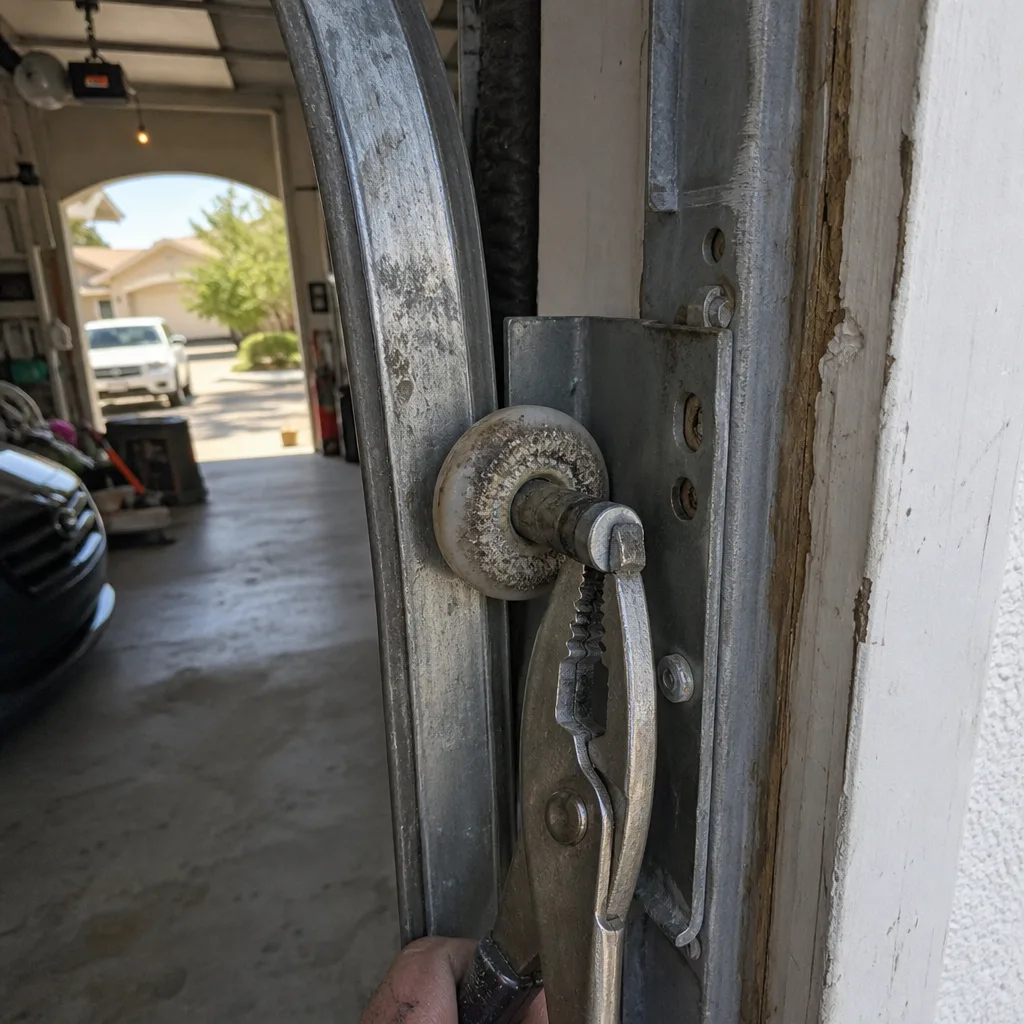
Before you ask about prices, ask for the license number. Every legitimate garage door contractor in Phoenix carries an Arizona Registrar of Contractors (ROC) license. The number should be printed on their website, their vehicle, their invoice, and their business cards. If it’s not, that’s your first fail. No license number on the page means no truck at your house.
Here’s the two-minute verification process:
- Get the license number. Ask for it directly. Don’t accept “we’re licensed” as an answer. Request the six-digit number.
- Go to the Arizona Registrar of Contractors website. Navigate to the license search page. The ROC maintains a public lookup tool that is free and doesn’t require an account.
- Enter the number. Confirm the business name matches, the license status reads “Active,” and the license class covers garage door work. In Arizona, garage door installation and repair falls under specific residential contracting classifications, and a specialty license may apply for door and hardware work. If the license class is, say, landscaping, that’s a red flag.
- Check the effective date and any complaints. The ROC database shows when the license was issued and whether any disciplinary actions exist. A license issued six months ago with three unresolved complaints is not the same as one held by a contractor operating continuously since 2015.
Phoenix gets a lot of out-of-state contractors chasing the summer storm season, when opener failures and panel dents spike. An LLC registered in Nevada or Texas with a Phoenix phone number is not the same as a contractor who holds a current Arizona ROC license. The license database is free and public. Use it.
Step 2: Require a Written Quote Before Any Work Begins
A legitimate written quote is not a text message that says “spring plus labor, around $350.” A legitimate written quote is a document you can hold someone to. In our business, written pricing before any work starts is Clause 1 of The Haven Standard, the operating standard we work under. It is non-negotiable, and you should make it non-negotiable with whoever you hire.
Here is what a legitimate written quote must contain:
- The specific part number. Not “a spring.” A 0.225-inch wire diameter torsion spring, with the manufacturer’s part number if applicable. Torsion springs are rated by wire diameter, inside diameter, and length. If the quote says “springs” without specifics, ask for the part number.
- The part cost. A dollar figure for the component itself.
- The labor cost. A separate dollar figure for installation time.
- The total. One number, not a range. “Between $300 and $500” is not a quote. It’s a guess that will land at $500.
- The condition that would change the total. This is the line most contractors leave out, and it’s the line that protects you. A legitimate quote states what would have to change for the price to change. Example: “If the center bearing plate is cracked, the replacement is an additional $95.” That’s documented, in advance, in writing.
If the quote omits the condition that would change the total, the technician can always find something that “had to be addressed.” The omission is the point. Require the condition line.
Once you have a written quote from one contractor, you have leverage with the next one. A written quote tells the second bidder you’re not going to be upsold. It tells the first bidder you know what you’re doing. You can compare part numbers, labor hours, and conditions side by side. That’s how you hire well.
Step 3: Ask These Five Questions Before a Technician Opens a Tool Bag
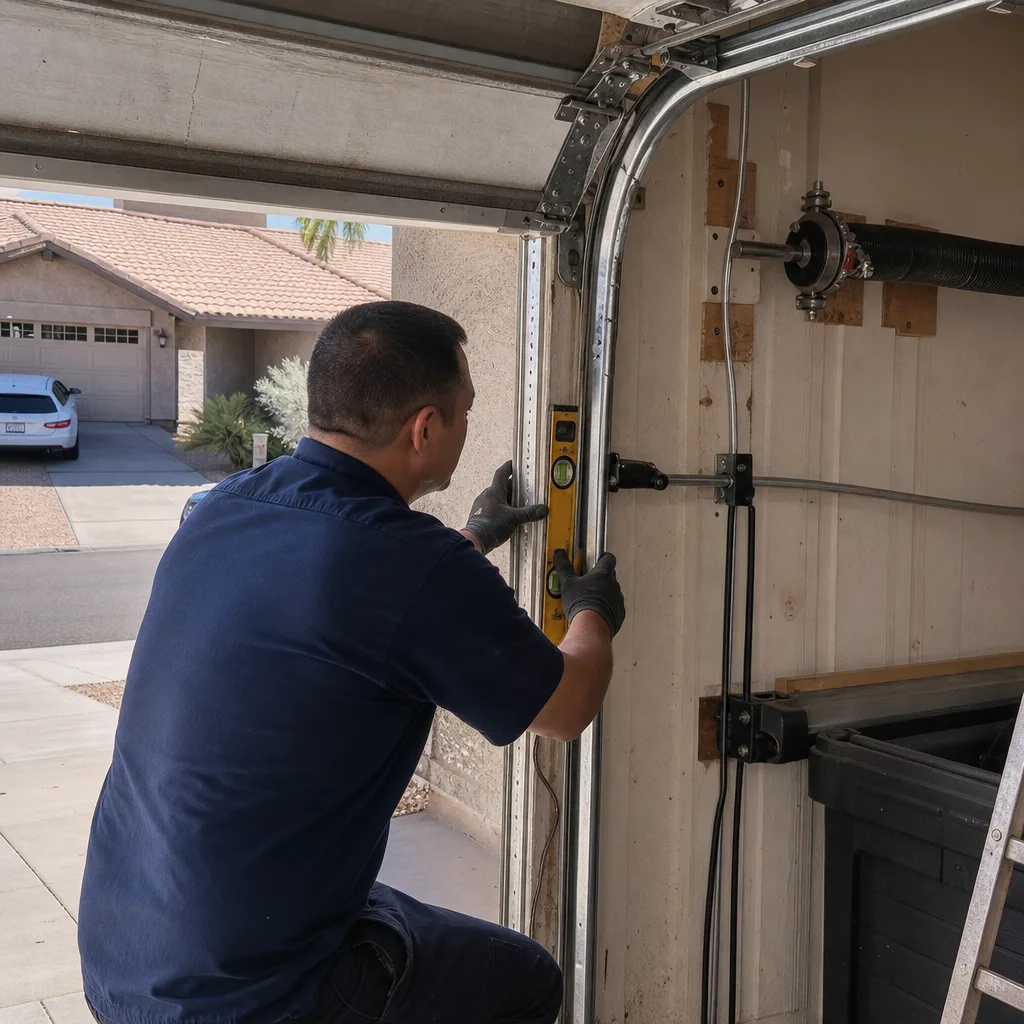
These five questions are your screen. Each one has an answer that passes and an answer that doesn’t. Ask them in order, before the technician touches a bolt. If any answer fails, end the visit and move on.
Question 1: “Can you give me a written, fixed price before you start any work?”
Pass: “Yes. I’ll inspect the door, write down what I find, and give you a flat price with a written scope before I touch anything.” Fail: “Well, I can give you a ballpark, but I won’t know for sure until I get into it.” You now know the total can move. Walk.
Question 2: “Will the price change once you see the door in person?”
Pass: “The price I quote you is the price you pay, unless we find a specific condition that we’ll document and agree on first.” Fail: “It depends on what we find.” If the quote can move based on what they “find,” they control what they find. The condition must be named and priced before work begins.
Question 3: “What part number are you quoting me?”
Pass: The contractor names a specific part, with specifications. “A pair of 0.225-inch wire diameter torsion springs, inside diameter 2 inches, rated for 10,000 cycles.” Fail: “Standard springs. Whatever fits.” You want to know what you’re paying for before you pay for it. If they can’t name the part, they may be substituting cheaper components.
Question 4: “Do you carry the parts on your truck?”
Pass: “For common repairs like springs, rollers, cables, and opener logic boards, yes. I carry them.” Fail: “I’ll need to run to the supply house.” That’s a real answer for uncommon parts, but if a technician doesn’t carry torsion springs, rollers, and common opener components in Phoenix, they’re not doing daily repair work. They’re doing occasional work.
Question 5: “Will I receive a written record of what you found and what you did?”
Pass: “You’ll get a documented photo record of what I found before I fix it, and photos of the completed work.” Fail: “I’ll tell you what I did.” A verbal summary is not a record. This is Clause 4 of The Haven Standard: the customer sees the failed part before anyone quotes a replacement. We photograph the broken spring, the stripped gear, the cracked panel. You see it. Then you decide.
Step 4: Understand Service Call Fees vs. Diagnostic Fees
These are two different charges, and Phoenix contractors use the terms interchangeably to confuse homeowners. Know the difference before you schedule.
A service call fee is the charge for the truck showing up. It covers drive time and the base overhead of dispatch. It is usually applied toward the repair if you proceed.
A diagnostic fee is the charge for identifying the problem. It is the cost of the technician’s labor and expertise in determining what failed and what it will take to fix it. Sometimes it’s folded into the service call fee. Sometimes it’s separate.
The question to ask before the truck arrives: “Do you charge a service call fee or a diagnostic fee, and is it applied toward the repair if I approve the work?”
The answer that passes: “We charge a flat $X service call fee and apply it toward the repair. If we can’t fix it, you owe nothing beyond the call fee.” The answer that fails: “It depends on what we find.” Any fee that can move is a variable, not a fee.
In Phoenix’s hot market, some operators advertise “free estimates” and then charge a diagnostic fee once the door is in pieces. Ask for the fee structure in writing before you book. And if the company says “we don’t charge a fee,” ask what happens if you decide not to proceed. A real business answers that question without blinking.
Step 5: Spot Phoenix-Specific Red Flags Before You Schedule
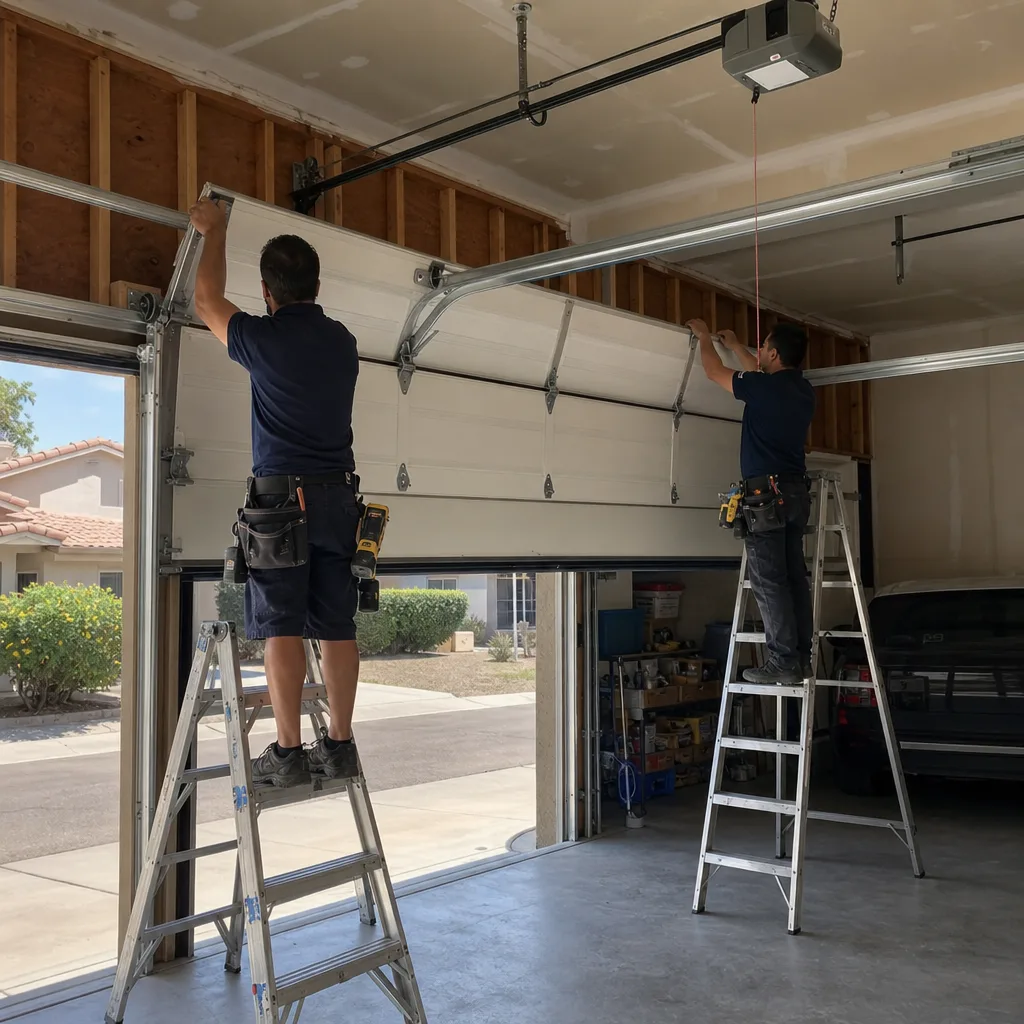
Phoenix has a high-volume transient contractor market. The city’s growth, the age of its housing stock, and the volume of out-of-state newcomers create a steady stream of homeowners who need a garage door fixed and don’t know who to call. That demand attracts operators who are not accountable to a local reputation.
Here are the red flags specific to Phoenix:
- Out-of-state LLCs with local phone numbers. A quick business search shows the company registered in Nevada, Texas, or Delaware. Local phone number is easy to get. Local accountability is not.
- No physical address on the invoice or website. A PO box in Mesa or a registered agent’s office in Tempe is not a shop. If you can’t find a physical location, the company can vanish.
- Quotes given in a price range rather than a fixed number. “Spring replacement, $350 to $600.” See Step 2. No legitimate contractor quotes a range for a standard torsion spring replacement. The part is what it is. The labor is what it is. The range is a lever.
- “One-day-only” pricing or seasonal urgency. “Summer heat wears out springs, so prices are going up.” Weather affects failure rates in Phoenix. It does not affect the price of a spring. A contractor who invents urgency is selling fear, not repairs.
- No license number on the truck or the estimate. See Step 1. In Arizona, the license number belongs on the vehicle, the invoice, and the proposal. If it’s missing, ask for it. If it’s still missing, do not hire them.
The desert climate here does have genuine effects on garage door hardware. Extreme heat accelerates spring fatigue, particularly on doors facing south or west. A spring that would last 10,000 cycles in mild climates often fails at 7,000 to 8,000 in Phoenix. That’s a real fact worth knowing. It’s also irrelevant to whether a contractor writes an honest quote. Don’t let a technician use weather as a pricing argument.
Step 6: Read a Written Quote Like a Contract
Once you have a written quote in hand, read it like a document that will govern the job, because it should. Here’s what to look for:
- The company’s name and physical address. Not just a phone number. A real address.
- The ROC license number. Printed on the quote, not available “on request.”
- A line-item breakdown. Part, part cost, labor, labor cost, total. If the total is a single number with no breakdown, ask for the lines.
- The warranty terms. What’s covered, for how long, and what’s excluded. A one-year warranty on parts and labor is standard for quality work. A 90-day warranty is not automatically a fail, but a company offering only 90 days on a torsion spring is telling you something about the quality of the parts they source. For reference, we back our work with a 365-Day Done Right Promise, and it applies to every repair we make.
- The condition that changes the total. See Step 2. If it’s missing, the quote is incomplete.
- The name of the technician who will do the work. Not the salesperson who sold it. The person who shows up.
A written quote that passes all these checks is rare. Most contractors in the Phoenix market won’t produce one because it removes their flexibility. But flexibility is not what you want from a contractor. You want accountability. The written quote is the only mechanism that delivers it.
One more point on discipline: once you get a written quote, don’t share it with a competitor to see if they’ll beat it by $20. That’s not the game. The game is to determine whether the contractor operates with transparency. The $20 difference matters less than the difference between a contractor who writes things down and one who won’t. Our garage door repair in Phoenix work always starts with the written scope, because it removes the only real variable: the contractor’s willingness to stand behind a number.
Common Mistakes to Avoid
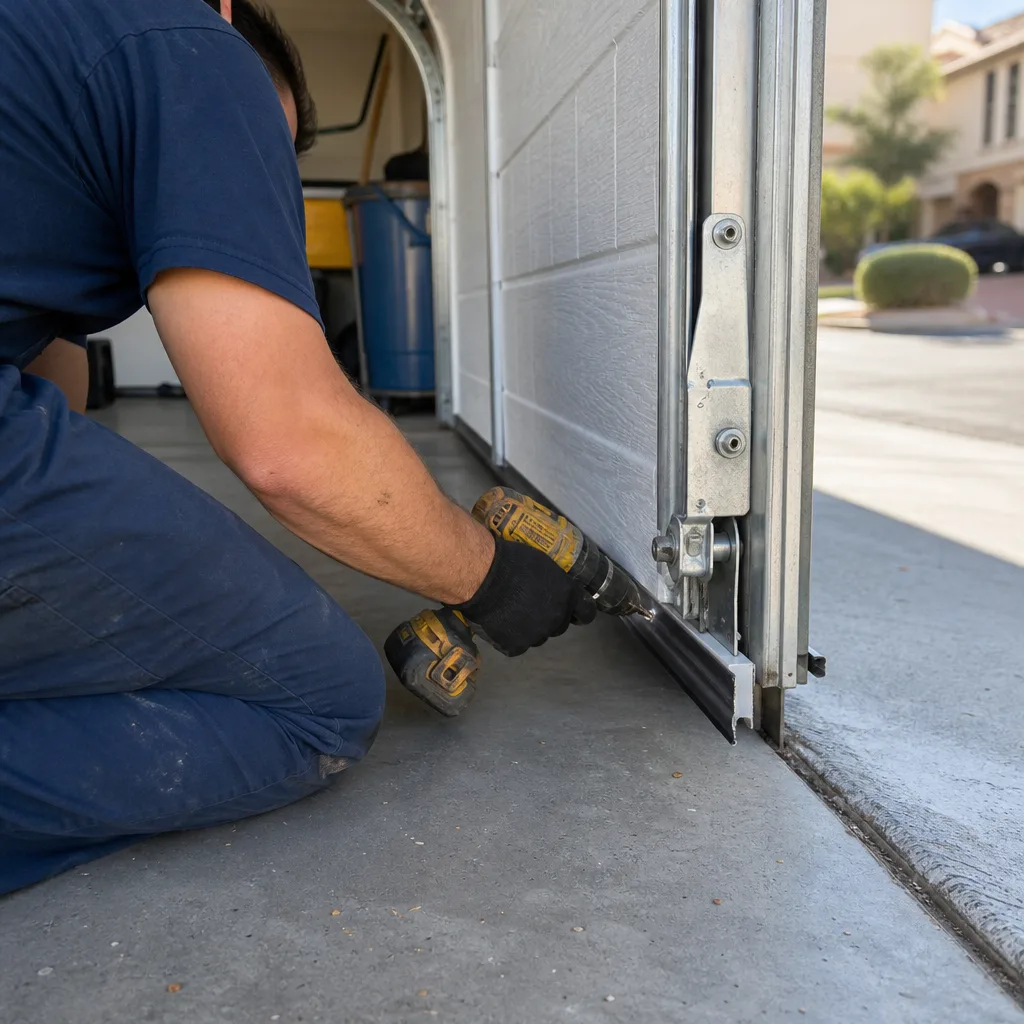
- Authorizing teardown before a written quote exists. Once the door is in pieces, you lose leverage. Require the paper first.
- Comparing quotes by total only. Two quotes for $400 can mean two very different things. Read the line items, not the bottom number.
- Not checking the ROC license because “the reviews are good.” Reviews can be gamed, purchased, and curated. The license database cannot.
- Assuming a big national brand means consistent quality. National chains are common in Phoenix, but the technician at your door is a person, not a brand. Ask the same five questions regardless of the logo on the truck.
- Paying the full amount upfront. A deposit for a custom door order is legitimate. Full payment before the door is installed is not. Never pay in full before the work is done and documented.
- Trusting a price given over the phone without photos. A phone quote is a guess. A written quote follows an inspection. If you need a new door, garage door installation in Phoenix always starts with a measurement and a written scope, not a phone number.
- Rushing into a decision the same day. Urgency is a sales tactic. A genuine repair can almost always wait until you’ve done the verification. The only exception is a door that won’t close, which is a security issue. Even then, you have time to verify a license.
When to Call a Professional
Some jobs are not DIY. High-tension torsion springs store enough energy to cause serious injury or death if they release improperly. A garage door that won’t close is a security problem: your home is open to the street. If your opener hums but the door won’t move, the issue could be the logic board, the trolley carriage, or the drive gear, and diagnosing it requires a multimeter and some patience. If you’re not confident, don’t guess. Garage door opener repair and installation in Phoenix is work that goes wrong quietly and expensively when it’s done wrong. Servo Garage Doors Phoenix offers free estimates in Phoenix. Call (623) 404-9080 and we’ll send a uniformed, background-checked technician with a written quote before any work begins.
Frequently Asked Questions
Torsion spring replacement in Phoenix typically ranges from $180 to $340 for a standard single door, depending on the spring’s wire diameter, cycle rating, and whether the technician replaces one spring or a pair. The written quote you receive should show the exact part number and the labor as separate lines. If the quote is a range instead of a fixed number, ask for the condition that would change the total. Call (623) 404-9080 for an exact written quote, not a ballpark.
When one torsion spring fails, both springs are usually near the end of their service life, especially in Phoenix where heat accelerates metal fatigue. Replacing both ensures even tension and prevents a second failure in three months. A technician who recommends both should explain why, in writing, and show you the condition of the unbroken spring. The decision is yours after you’ve seen the evidence.
Yes. Emergency garage door calls are answered by a live person 24/7 in Phoenix, including holidays, and a named technician gets dispatched with a text when they’re on the way, not a callback window. If your door is stuck open and the sun has been on it all afternoon, the heat may have caused the metal tracks to expand, which is a common Phoenix-specific failure. A technician can diagnose it and give you a written price before doing anything.
Torsion spring failure is by far the most common issue we see in Phoenix, usually when daytime highs stay above 100 for consecutive weeks and doors face south or west. The heat causes metal fatigue and reduces the spring’s cycle life. A spring rated for 10,000 cycles in a mild climate often fails at 7,000 to 8,000 here. The repair is straightforward and typically completed in under an hour with the right parts on the truck.
Yes, and we tell you the amount before you book, in writing. The service call fee covers the dispatch and diagnosis, and it’s applied toward your repair if you approve the work. If you decide not to proceed, you owe only the call fee. There is no separate “diagnostic fee” added on once we’re at your house, and there is no charge you haven’t seen before the truck arrives.
For common repairs like torsion springs, extension springs, rollers, cables, hinges, and opener components including logic boards and trolley carriages, yes. Our technicians run stocked trucks in Phoenix because most repairs are standard and shouldn’t require a trip to a supply house. If your door has an uncommon configuration, we’ll tell you during the estimate call and schedule a specific return visit with the right parts, quoted in advance.
The Bottom Line
Hiring a garage door contractor in Phoenix is not about finding the lowest price or the best reviews. It’s about finding the contractor who will document everything before touching your door. Verify the ROC license. Require a written, fixed quote with a line-item scope. Ask the five questions and accept nothing less than a pass on each. Confirm the fee structure before the truck arrives. If a contractor won’t do these things, they’re telling you how the job will go. The paper trail is the product. Everything else is theater. If you want a contractor who operates this way, Servo Garage Doors Phoenix has been serving Phoenix since 2015. Call (623) 404-9080 for a free estimate, and we’ll send a technician with a written price before any work starts. For an overview of what we do, visit our Servo Garage Doors Phoenix home page.
Written by Marcus Deller, Owner at Servo Garage Doors Phoenix, serving Phoenix since 2015. Explore more guides & resources.