
Last updated September 20, 2026
Full 25-point door and opener safety check with every visit - springs, cables, rollers, tracks, and your LiftMaster or Chamberlain opener included
You get a price before we start. It does not change when the truck arrives.
 Before
 After
After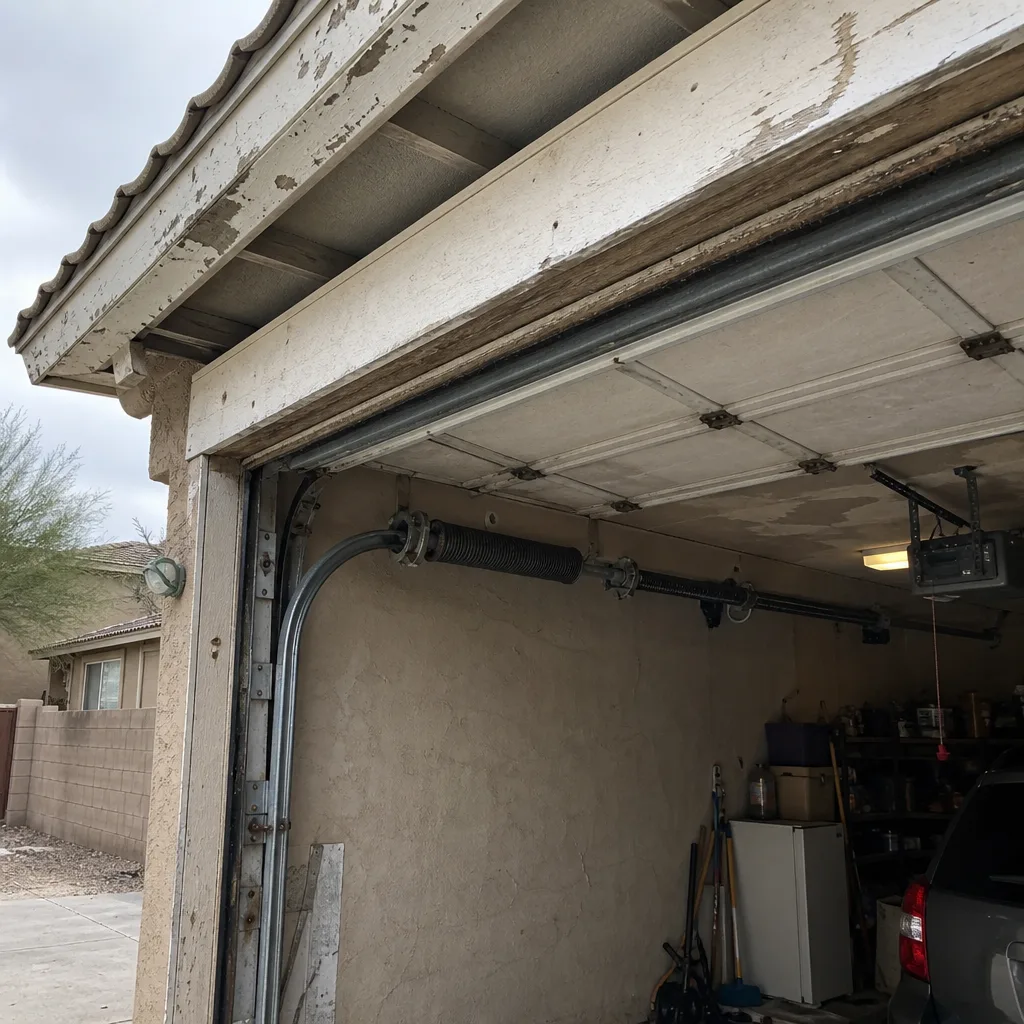 Before
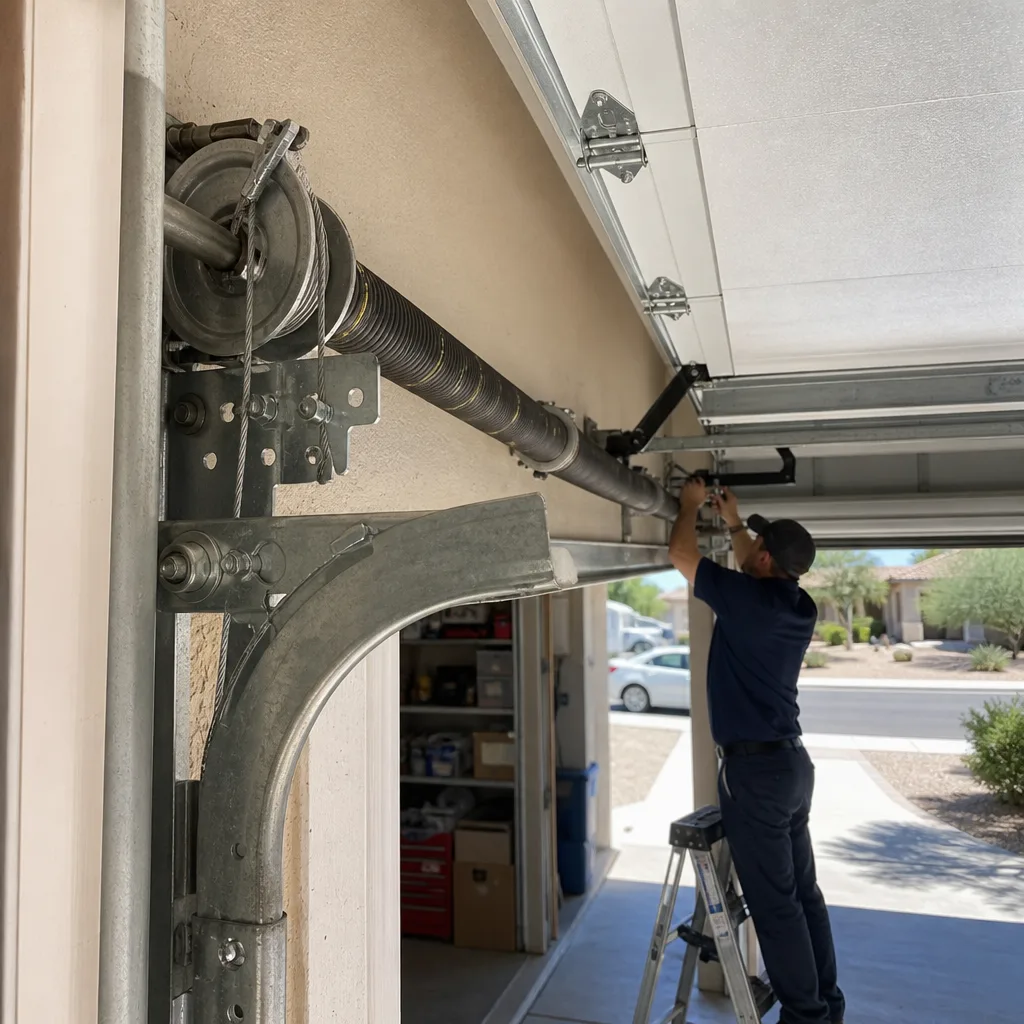 After
After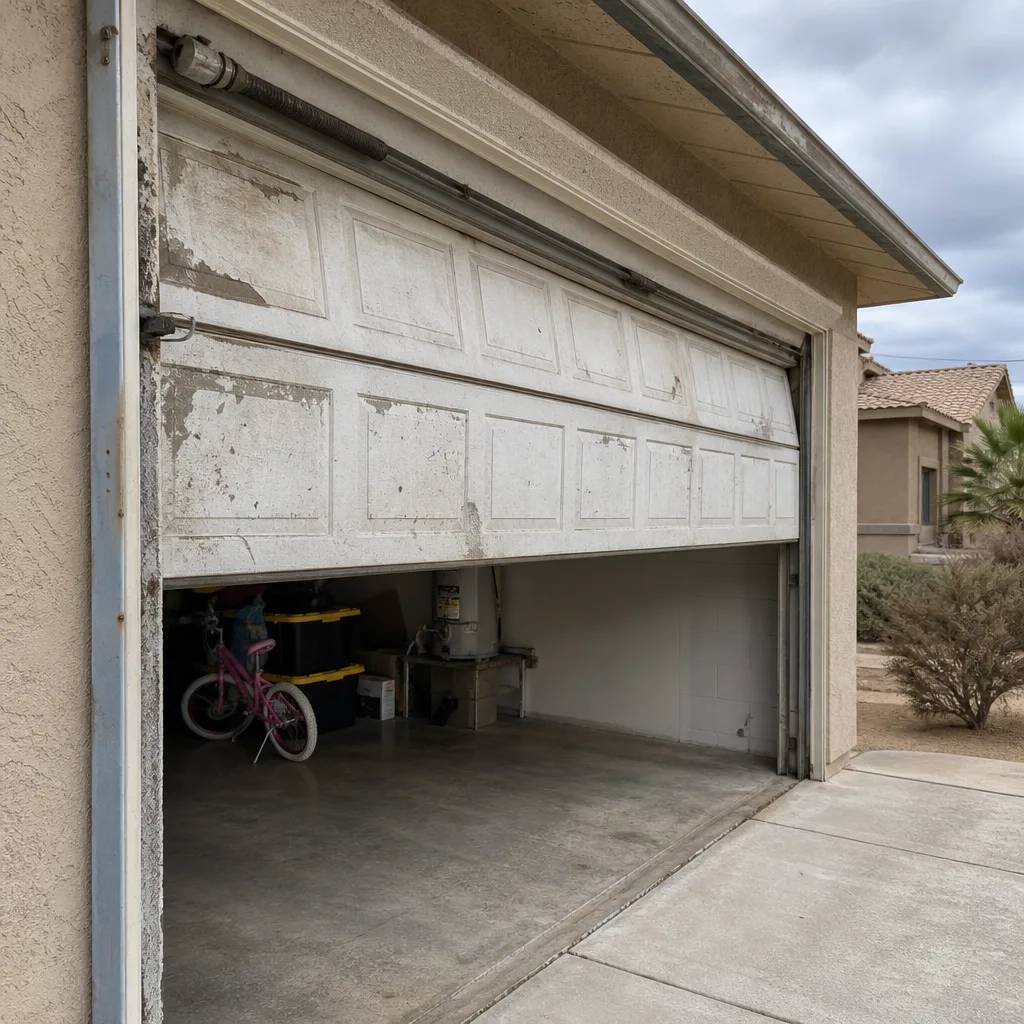 Before
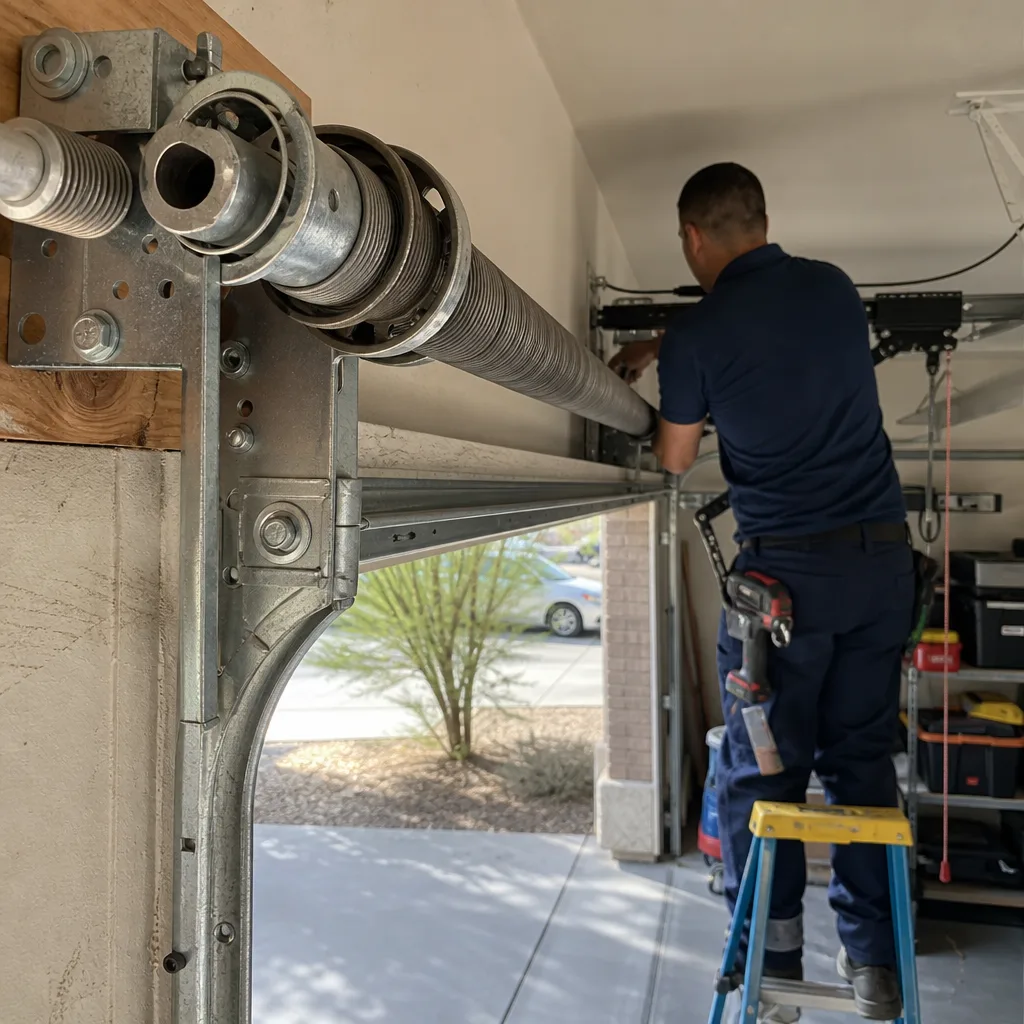 After
AfterThe Complete Guide to Garage Door in Phoenix
Phoenix averages 299 sunny days a year, and ultraviolet radiation degrades polypropylene door sections at roughly twice the rate seen in temperate markets. Yet most installation specs printed on the door jamb were written for Chicago. A garage door in Phoenix doesn’t fail the way a garage door in Minneapolis fails. It fails in a predictable sequence, driven by heat, UV, and dust rather than ice, salt, and moisture. This guide maps that failure chain from the bottom seal up through the springs, tracks, and opener, so you know what you’re actually maintaining when you own a garage door in Phoenix. For more guides & resources, see our blog. You’ll learn which components fail first, what they cost to replace, and how to tell whether a repair is worth doing or whether you’re patching a system that was mismatched from the start.
Quick Answer
A Phoenix garage door is a system of components that degrade in a specific order under desert heat and UV: the bottom weatherstrip and exterior seals go first (typically 2 to 4 years), followed by torsion springs (5 to 8 years), rollers and cables (7 to 10 years), and the opener’s logic board if the unit is mounted in an uninsulated garage that regularly exceeds 130°F. Understanding this sequence lets Phoenix homeowners replace components before they cascade into larger failures, and most repairs cost between $120 and $380 when caught early. The key to buying once instead of twice in Phoenix is matching the door’s steel gauge, spring cycle rating, and weatherstrip polymer to the actual thermal conditions your garage experiences, not the national-average spec. For a detailed look at how these choices affect your budget, see our Garage Door Cost Breakdown: The Phoenix Homeowner’s Reference for 2026.
Table of Contents
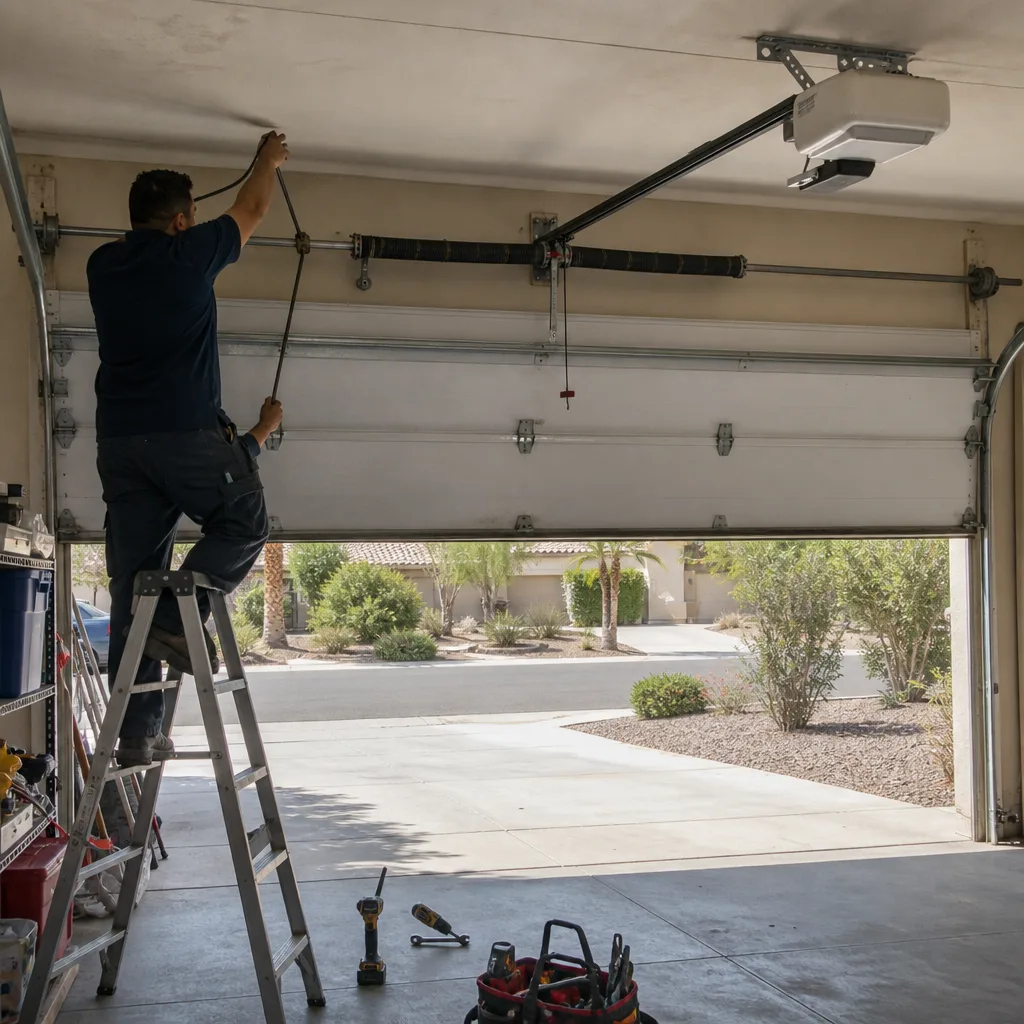
- How the Phoenix Climate Attacks Your Garage Door
- The Phoenix Failure Timeline: What Goes First
- Steel Gauge and Thermal Expansion: What 24-Gauge vs 25-Gauge Actually Means in Phoenix
- The R-Value Problem: Why That Insulation Number Isn’t Doing What You Think
- Component Replacement Intervals for Zone 2B Desert Climate
- How to Read Your Door’s Data Plate and Know If You’re Patching a Mismatch
- Common Mistakes to Avoid
- When to Call a Professional
- Frequently Asked Questions
BeforeAfterHow the Phoenix Climate Attacks Your Garage Door
The Sonoran Desert doesn’t just make garage doors age faster. It ages them in a specific order, and that order matters. In Phoenix, three environmental forces do the damage: ultraviolet radiation, sustained ambient heat, and fine alkaline dust. Each one attacks a different component.
UV is the silent killer of anything polymer-based. A garage door’s bottom seal, side weatherstrips, and vinyl trim are made from PVC or EPDM polymers that cross-link and embrittle under prolonged UV exposure. In a temperate climate, these polymers might last 6 to 8 years before cracking. In Phoenix, we regularly see bottom seals that have turned rigid and split by year 3. The rubber loses its flexibility, gaps open at the corners, and the door no longer seals against the threshold. From there, dust enters, and dust is abrasive.
Sustained heat attacks metals differently. Steel panels, tracks, and hardware expand and contract across a wide daily range. A Phoenix garage that’s 68°F at 6 a.m. can hit 140°F inside by 3 p.m. in July. That’s a 70-plus-degree daily swing. Metal expands roughly 0.0000065 inches per inch per degree Fahrenheit for steel. On a 16-foot-wide door, that’s measurable. Tracks that were installed tight at 70°F will bind at 140°F if they weren’t set with desert expansion gaps. Springs that were wound for temperate conditions will lose tension faster because heat accelerates the fatigue that every torsion spring undergoes with each cycle.
Then there’s the dust. Phoenix’s fine, alkaline soil dust works itself into rollers, hinges, and bearing plates. It acts as a mild abrasive, scoring the roller stems and wearing out nylon roller bearings faster than in cleaner climates. The result is a door that gets progressively noisier and rougher in operation, even when nothing has visibly failed.
What this means practically: a Phoenix homeowner who treats their garage door the way a Chicago homeowner does will replace components reactively, one at a time, always after they’ve already failed. The better strategy is to understand the sequence, inspect the high-risk components seasonally, and replace things on the desert timeline rather than the national timeline.
The Phoenix Failure Timeline: What Goes First
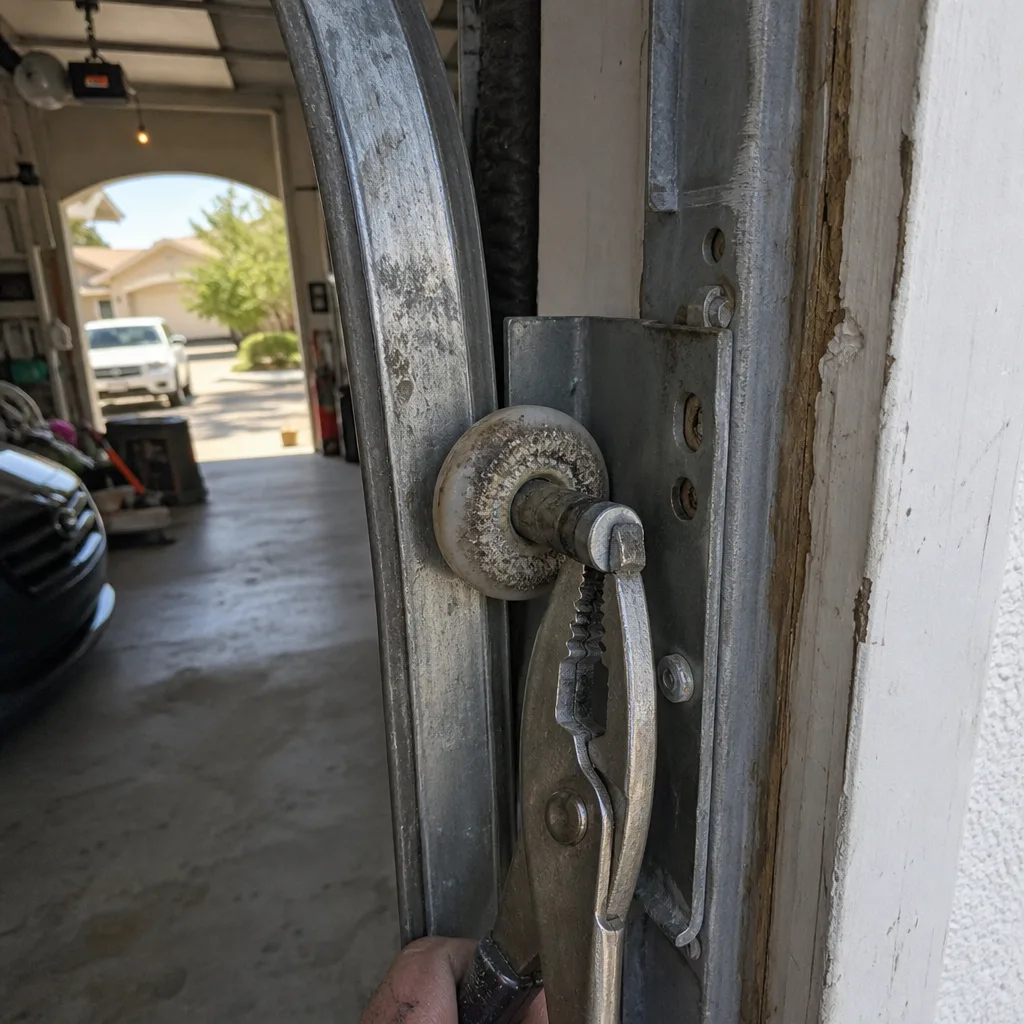
Here’s the sequence we see across thousands of garage doors in Phoenix, tracked since 2015. It’s the order in which problems actually occur in this climate, not the order a national guide would list.
Year 1 to 3: Bottom Seal and Weatherstripping Failure
The bottom T-seal (the rubber strip that runs along the bottom edge of the door) hardens in direct sun. The side and top weatherstrips, which seal the perimeter, crack where they bend around the corner brackets. Symptoms: daylight visible under the door, dust accumulation at the threshold, higher garage temperatures, and the occasional lizard or scorpion finding its way in. Replacement cost: $90 to $180 for the seal and labor. This is the cheapest repair on the list, and the one most often ignored until it causes something else to fail.
Year 3 to 6: Roller and Hinge Wear
Nylon rollers have a design life of 10,000 to 15,000 cycles, but Phoenix dust accelerates bearing wear. Steel rollers on older doors last longer but get noisy. Symptoms: a grinding or chattering sound when the door moves, slight wobble in the panels, uneven gaps between sections. Replacement cost: $80 to $160 for a full roller set on a single door. If ignored, worn rollers transfer stress to hinges, which stretch their pin holes and create panel sag.
Year 5 to 8: Torsion Spring Failure
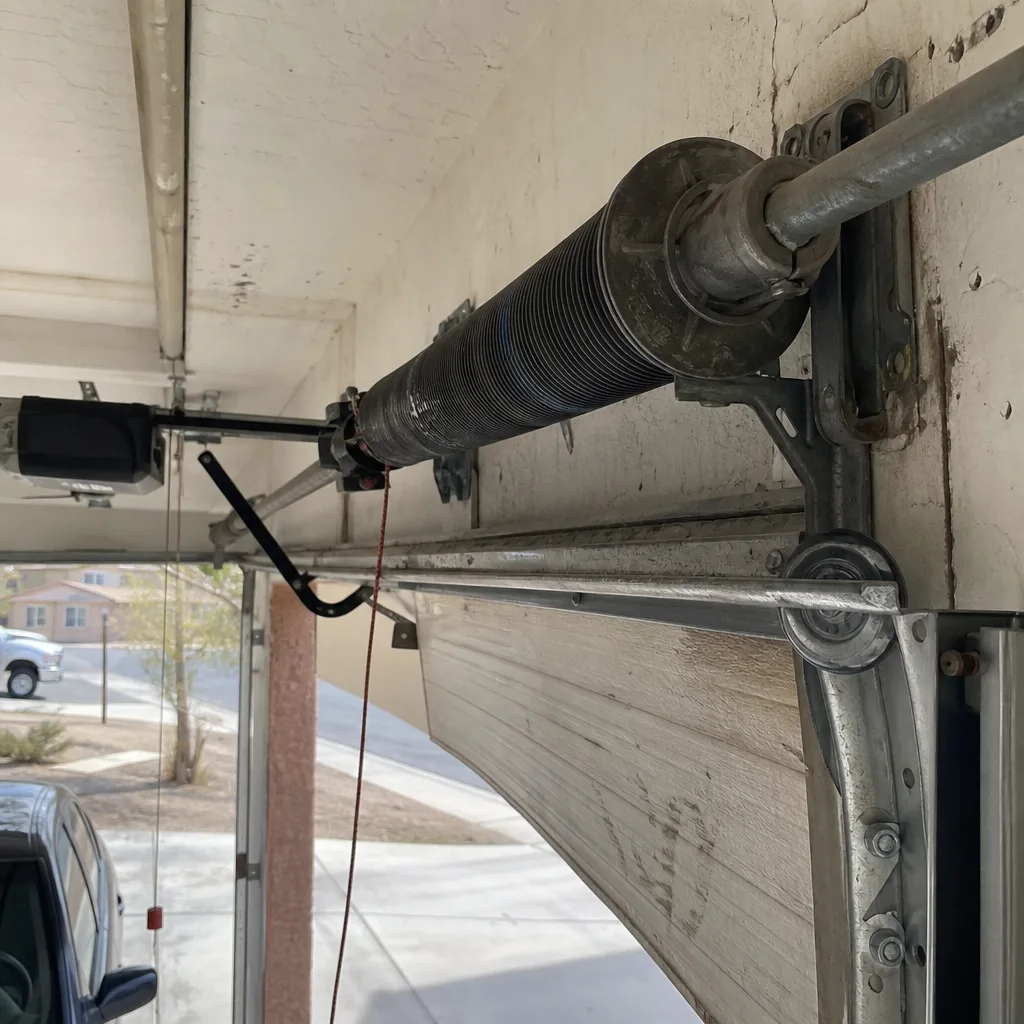
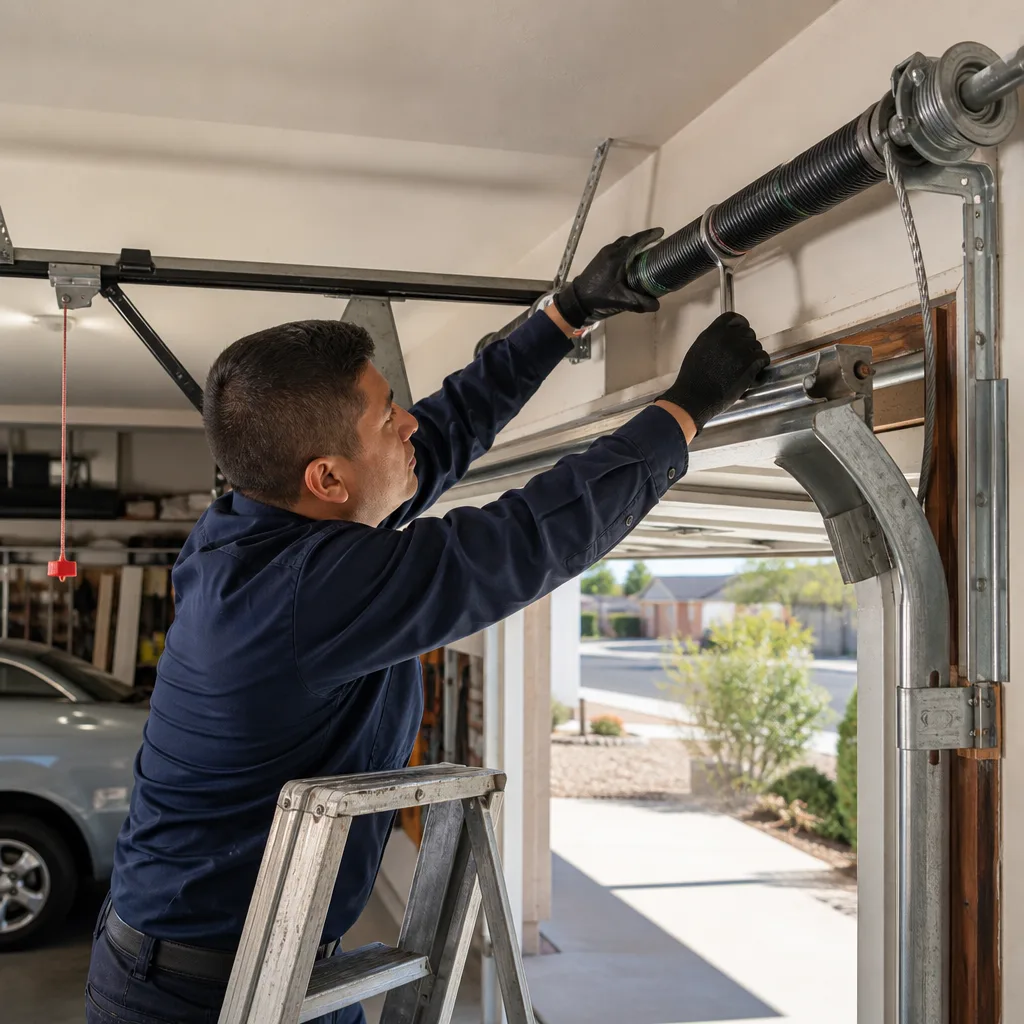
Torsion springs are rated by cycle life: 10,000 cycles is standard on builder-grade doors, which translates to roughly 7 to 9 years of typical use in a Phoenix home where the door cycles 4 times a day. Heat accelerates the fatigue. When a spring breaks, it’s sudden and loud, and the door won’t lift manually. Replacement cost in Phoenix: $180 to $340 for a single spring installed, $320 to $580 for a pair. Whenever one spring breaks, both should be replaced; the second is at the same fatigue point. This is garage door repair in Phoenix at its most common: spring failures account for the majority of our emergency calls between May and September, when the heat peaks.
Year 7 to 10: Cables and Drum Wear
Cables are steel strands that wind around drums above the spring assembly. They don’t fail from overload; they fail from abrasion. When a slightly misaligned cable rubs against a drum flange for hundreds of cycles, individual strands fracture. Symptoms: fraying visible near the drum, the door lifting slightly unevenly, or a sudden failure where one side drops. Replacement cost: $130 to $220 for cables and drums on one door. Note: if a cable fails while the door is moving, the door can drop suddenly. This is one of the components where a visual inspection is worth scheduling.
Year 10 to 12: Opener Component Wear
The opener’s motor and drive mechanism are durable, but Phoenix heat shortens the life of the logic board and the capacitor. Capacitors, in particular, are heat-sensitive; a garage that hits 140°F regularly will cook a capacitor years before the motor itself fails. Symptoms: the opener hums but won’t move the door (capacitor failure) or behaves erratically, opening partway or reversing without cause (logic board). This is where garage door opener repair in Phoenix comes in. Replacement cost for a capacitor: $80 to $150. For a logic board: $130 to $220. For a full opener replacement: $300 to $600, installed.
Steel Gauge and Thermal Expansion: What 24-Gauge vs 25-Gauge Actually Means in Phoenix
Steel gauge is a measure of thickness, and the counterintuitive thing is that a lower number means thicker steel. A 24-gauge door panel is thicker than a 25-gauge panel. The difference between them is about 0.005 inches, or roughly the thickness of two sheets of printer paper. That doesn’t sound like much, but in Phoenix it matters. Here’s why.
Thermal expansion is proportional to the material’s temperature change, its coefficient of expansion, and its original dimension. Steel expands at about 6.5 microinches per inch per degree Fahrenheit. On a typical 16-foot-wide door, a temperature rise of 70°F across a summer morning (say, from 70°F before dawn to 140°F inside the garage at midafternoon) produces roughly 0.09 inches of linear expansion. That’s the panel growing by nearly a tenth of an inch across its width. Both 24-gauge and 25-gauge steel expand at the same rate; the difference is how they behave under that stress.
A 25-gauge panel is thinner and lighter. Under repeated thermal cycling in Phoenix, it’s more prone to oil canning, the visible warping or buckling that appears as a wavy reflection across the panel face. Thin panels also transfer more heat through to the garage interior and dent more easily. A 24-gauge panel holds its shape better under the same expansion stress and resists the minor impacts that happen when a car door opens too close or a basketball ricochets off the panel.
In terms of track gap: when a Phoenix garage door is installed, the vertical tracks need to allow for this expansion. A door that fits perfectly into its tracks at 70°F will bind at 140°F if the installer set the gap too tight. The difference between a properly set Phoenix installation and one done to northern spec is about 1 to 2 millimeters of side clearance. That’s the margin between a door that runs smoothly all summer and one that starts dragging in July. It’s also why a door installed by a company that doesn’t work primarily in the desert will often need track adjustment within its first two Phoenix summers. Before starting any work yourself, read our DIY vs Professional Garage Door: The Phoenix Homeowner’s Decision Guide.
The practical takeaway: if you’re choosing between a 24-gauge and 25-gauge steel door for a Phoenix home, and both are within your budget, the 24-gauge is the better investment in this climate. The material cost difference is typically $80 to $200 depending on the door size, and it buys measurable resistance to the exact failure modes Phoenix produces. For a full discussion of door options and what installation involves, see garage door installation in Phoenix.
The R-Value Problem: Why That Insulation Number Isn’t Doing What You Think
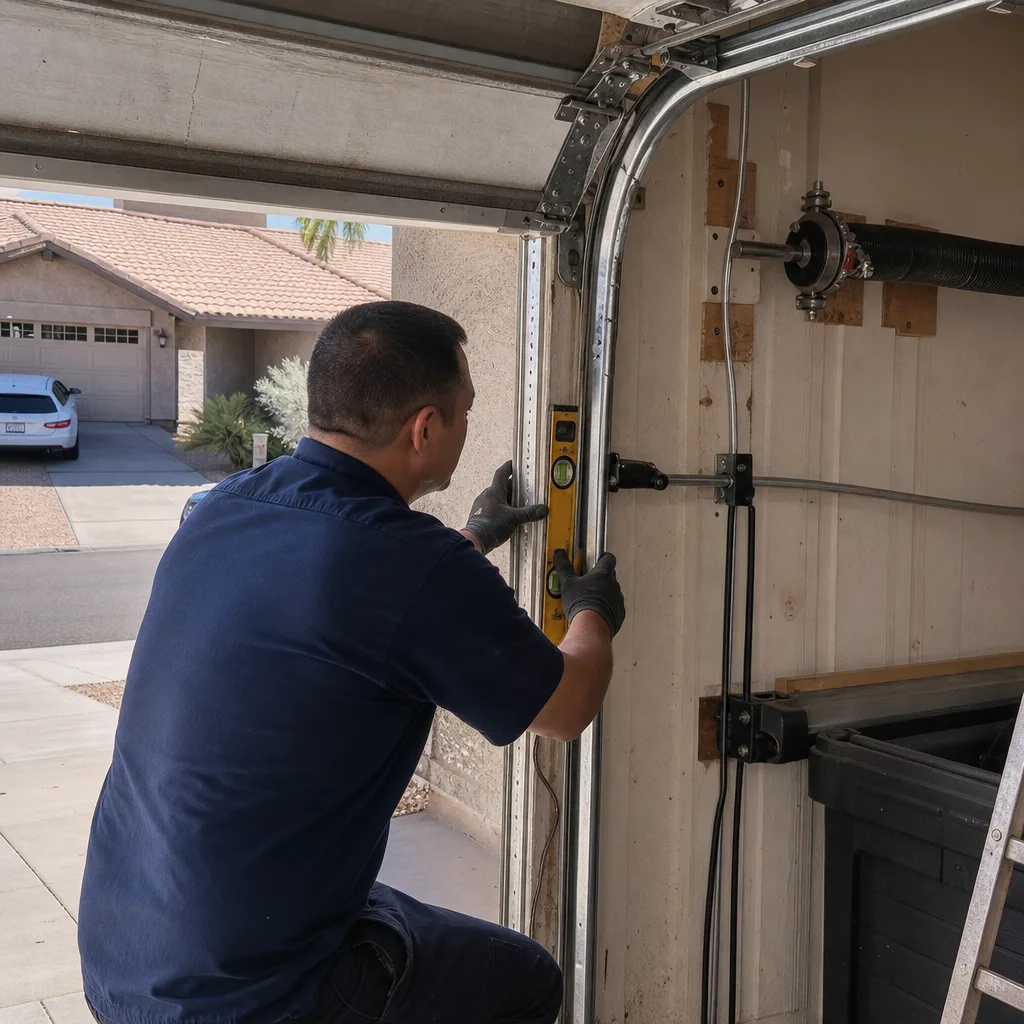
Garage door insulation is marketed with an R-value, and that number is tested at 70°F. Here’s what that means for Phoenix.
R-value measures thermal resistance: how well a material resists heat flow. Higher is better. A standard uninsulated steel door has an R-value around 2 to 3. A polystyrene-insulated door runs R-6 to R-9. A polyurethane-injected door runs R-12 to R-18. In a temperate climate, those numbers hold up reasonably well because the temperature differential between inside and outside is rarely more than 30 or 40 degrees. But R-value is not a constant; it’s a performance rating measured at a specific condition. When the temperature differential gets extreme, the real-world performance changes.
On a July afternoon in Phoenix, when the ambient air is 115°F and the sun is radiating directly onto your south-facing door, the door surface can reach 160°F or more. The garage interior may be 140°F. The differential across the door panel is 20 to 30 degrees, but the delta from the garage to the cooled areas of the house is massive. What an R-12 insulated door does in Phoenix is not what an R-12 door does in Seattle. It limits heat gain from the door itself, but it cannot offset the fact that the entire garage shell is absorbing heat from three uninsulated walls and a hot roof deck.
This matters for two reasons. First, if you’re buying an insulated door mostly to keep your garage comfortable in a Phoenix summer, know that insulation helps, but the bigger impact comes from sealing air gaps (the bottom seal and weatherstripping we covered above) and from keeping direct sun off the door face. A carport-shaded south-facing door will perform dramatically better than an unshaded one, regardless of the door’s insulation. Second, if you have a room above the garage, the door’s R-value matters less than the garage ceiling’s insulation. Heat rises; the attic interface is where your conditioned air is actually lost.
The sensible Phoenix approach: buy the insulation level appropriate to your use case. If your garage is a workshop or gym, a polyurethane door with an R-10 to R-14 rating is worth it. If it’s just parking and storage, an R-6 to R-9 polystyrene door plus good weatherstripping is a better value proposition than paying a premium for insulation that’s fighting a 140°F environment it can’t win against alone. Any honest Servo Garage Doors Phoenix home assessment will tell you the same thing when you ask about insulation options.
Component Replacement Intervals for Zone 2B Desert Climate
Phoenix sits in ASHRAE Climate Zone 2B: hot and dry. National garage door guides often quote replacement intervals that don’t distinguish Zone 2B from Zone 5. Here are the intervals we’ve documented from service records in Phoenix since 2015, with the reasoning for each.
Bottom Seal and Weatherstripping: Replace every 2 to 4 years
These are the sacrificial components. In Phoenix UV, PVC and EPDM embrittle predictably. During your annual inspection, bend the bottom seal with your finger. If it cracks or doesn’t spring back, it’s due. Cost: $90 to $180. This is the highest-value preventive replacement in Phoenix; a good seal keeps dust, pests, and heat out and extends the life of everything else.
Rollers: Replace every 5 to 7 years (or at first sign of bearing wear)
Nylon rollers with sealed bearings are standard now. In Phoenix dust, expect the lower end of that range. At the first sign of grinding or wobble, replace the full set; it’s a false economy to do one at a time. Cost: $80 to $160 for the set.
Torsion Springs: Replace every 7 to 9 years or at 10,000 to 15,000 cycles
Cycle count is the more accurate measure. If you cycle your door 6 times a day (leaving for work, returning, plus a couple of weekend errands), a 10,000-cycle spring lasts about 4.5 years. If you cycle it twice a day, the same spring lasts 13 years. Phoenix heat shaves roughly 10 to 15 percent off the rated cycle life. Cost: $180 to $340 per spring, or $320 to $580 for the pair. Here’s a guide to keeping track: most homeowners don’t count cycles, so treat age and use patterns as your proxy. If the home is new to you and the springs are over 7 years old, budget for replacement.
Cables: Inspect annually; replace at first sign of fraying
Cables don’t have a fixed interval, but they should be inspected as part of your annual check. Look at the strands where the cable wraps around the drum near the top of the door. Any broken strand means replacement is due. Cost: $130 to $220.
Opener Capacitor: Replace every 6 to 8 years in Phoenix heat
This is a desert-specific interval. A capacitor in a garage that regularly exceeds 130°F simply won’t last as long as one in a 90°F garage. When the opener hums but doesn’t move, this is usually the culprit. Cost: $80 to $150.
Opener Logic Board: Replace at 10 to 12 years, or on first failure
Heat is the logic board’s main enemy. If your opener is over 10 years old and behaving erratically, replacing the board is often the economical fix compared to a full opener replacement. But if the motor itself is also 10-plus years old, a full replacement may make more sense. Cost: $130 to $220 for the board, $300 to $600 for a full opener.
How to Read Your Door’s Data Plate and Know If You’re Patching a Mismatch
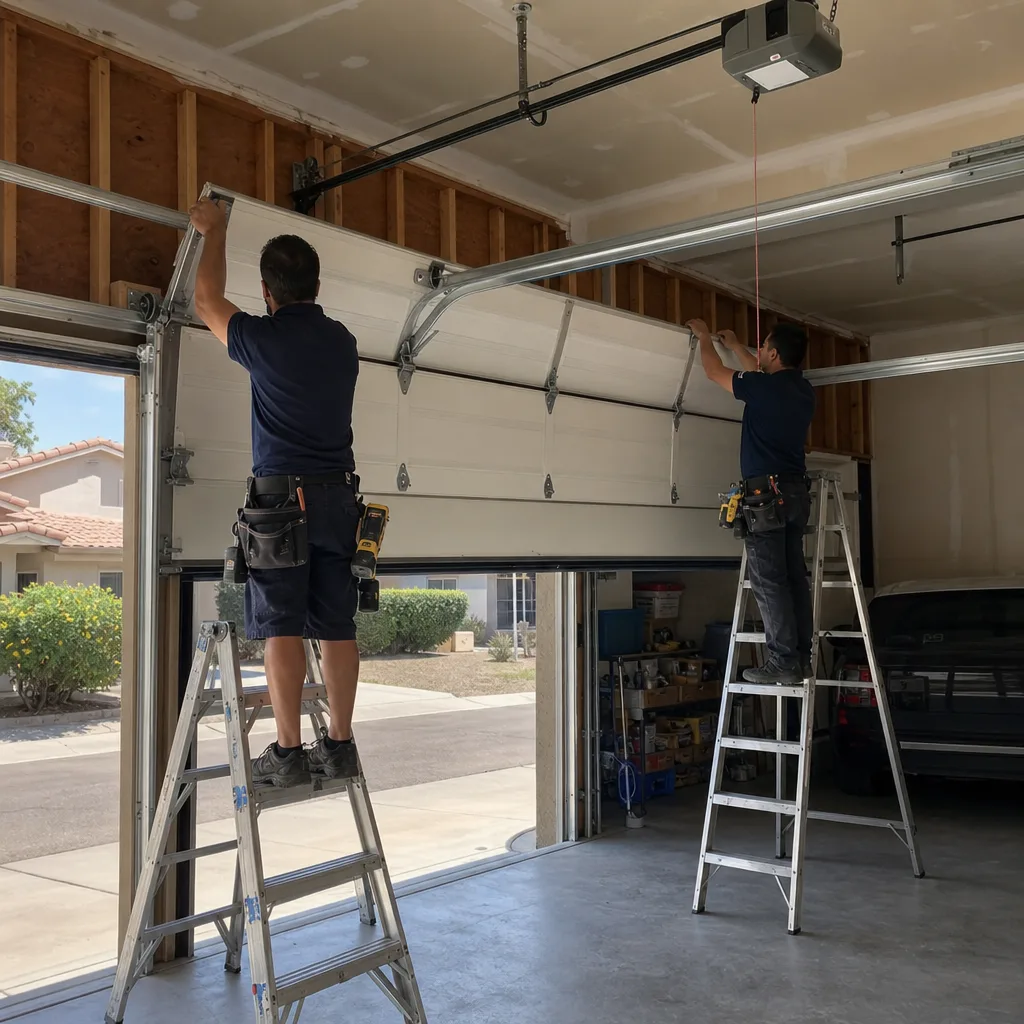
Every garage door has a data plate or label, usually on the end stile of one of the door sections, near the bottom or on the hinge side. It tells you the door’s manufacturer, model, and sometimes the spring(s) that were originally specified. Reading it takes five minutes, and it tells you whether a repair is extending the life of a coherent system or patching a mismatch.
Step 1: Find the plate
Look at the interior side of the door, near the bottom edge of a side section. Most manufacturers (Clopay, Amarr, Wayne Dalton, Raynor) place the label on the vertical stile at the bottom of the lowest panel or on the side of the top section. If the door is old and the label is painted over or torn, the door’s width, height, and weight become the identifying characteristics.
Step 2: Note the door’s weight and dimensions
The plate typically lists width, height, and door weight. Door weight is the critical number for spring sizing. A 16-by-7 door in 24-gauge steel typically weighs 150 to 180 pounds. A door with an added strut or insulation panel added later weighs more. If a previous owner installed added bracing or a heavier floor seal, the springs that were originally specified may now be undersized for the actual weight they’re lifting. Undersized springs fail early. Oversized springs cycle the door too fast and strain the opener.
Step 3: Check whether the springs match the door
The spring wire diameter, inside diameter, and length determine its torque. If you have a mixed pair, one spring of one specification and one of another, the door will lift unevenly and the springs will fail at different times. This happens when a previous repair replaced only the broken spring with whatever was on the truck rather than matching the surviving spring. In Phoenix, we see mismatched pairs on roughly one in eight repair calls. The fix is a matched pair, and the cost is the same as the spring replacement range above: $320 to $580 installed.
Step 4: Compare the opener’s rating to the door’s actual load
Openers are rated by horsepower and by the intended door type. A 1/2-horsepower opener on a heavy, insulated 16-foot door is working harder than it was designed to, which shortens its life. If the door plate shows a heavier door than the opener was rated for, and the opener is failing, replacing the opener with a properly rated unit (typically 3/4 HP or higher for heavier doors) is the correct fix. Brands we service routinely include LiftMaster, Chamberlain, Genie, and Craftsman, and we’ve seen the full range of mismatch scenarios across all of them.
The practical point: before you approve any repair, read the data plate. If the repair quote doesn’t account for the door’s actual weight and spring spec, it’s a patch, not a fix. At Servo, we photograph the data plate as part of the documented record on every visit, along with the failed component itself.
Common Mistakes to Avoid
- Ignoring a cracked bottom seal. In Phoenix, this is the gateway failure. A cracked seal lets dust in, which accelerates roller and hinge wear, and lets cooled air out, which raises your energy bill. A $120 seal replacement deferred for two years becomes a $200 roller set and a hotter garage.
- Replacing only one torsion spring. When one spring breaks, the other has completed the same number of cycles and is at the same fatigue point. Replacing only the broken one means you’ll pay another service call in 6 to 12 months and risk the door coming down unevenly in the meantime.
- Buying a door specified for a northern climate. A door spec’d for Chicago was built for cold and moisture, not UV and heat. Phoenix doors need UV-stabilized weatherstrips and desert-expansion track clearances. We see this mistake most often with doors ordered online and installed by a generalist.
- Assuming a higher R-value solves a hot garage. Insulation helps, but without sealed air gaps and shade on the door face, an R-18 door in a Phoenix summer still lets the garage hit 130°F. Fix the sealing first, address shade if possible, then evaluate insulation.
- Lubricating springs and rollers with the wrong product. WD-40 is a solvent, not a lubricant. It strips what little lubrication exists and attracts dust. Use a silicone or lithium-based product designed for garage doors, and wipe off the excess. Phoenix dust sticks to whatever you leave behind.
- Skipping annual spring and cable inspection. These are the two components that fail suddenly and without warning. A visual check takes minutes and can spot fraying or fatigue before it becomes a 2 a.m. emergency call.
- Patching an old mismatched system instead of assessing it as a whole. If the data plate shows one thing and the installed springs show another, each individual repair will still leave you with a mismatched, premature-failure system. At some point, the honest fix is a full spring-and-cable replacement matched to the door’s actual weight.
When to Call a Professional
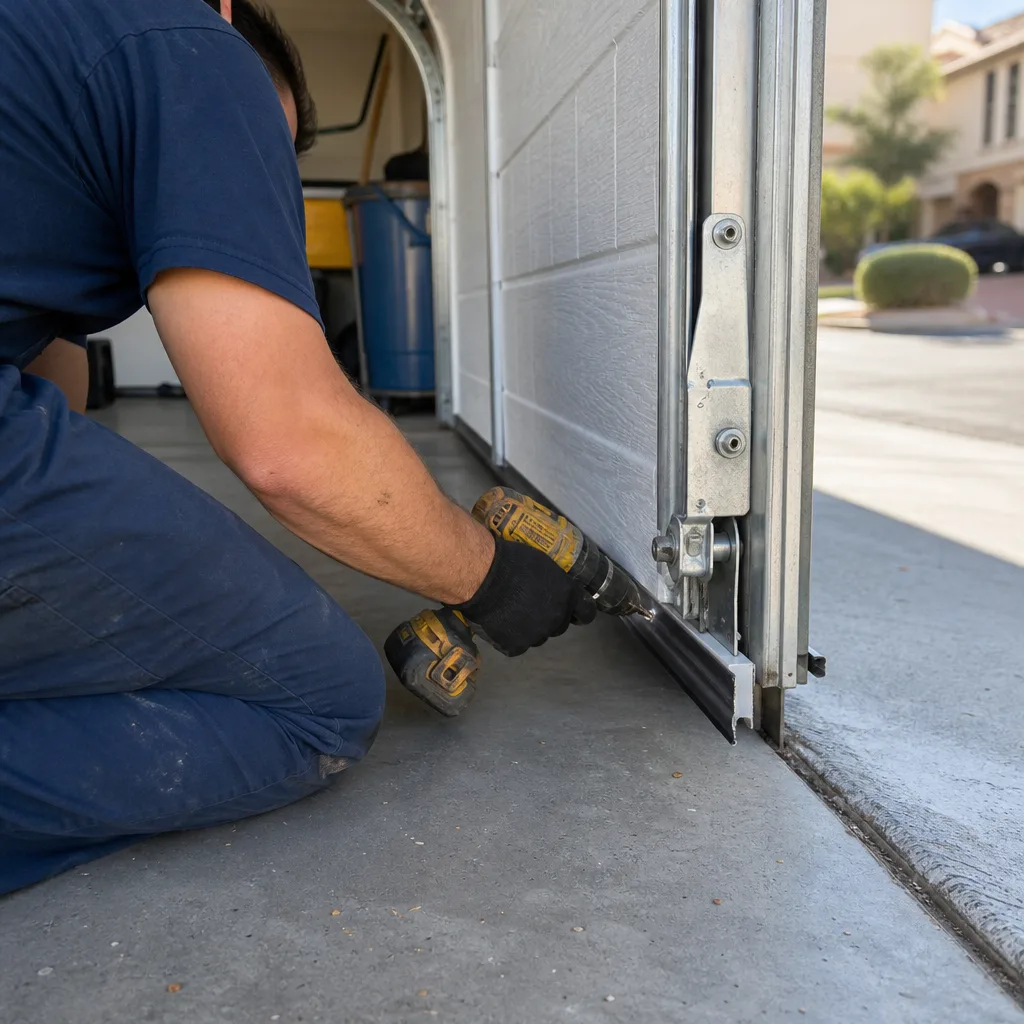
Two situations warrant a professional immediately: a broken torsion spring and a cable that has snapped or frayed. Both involve high-tension components that can cause serious injury if handled without proper tools and training; a torsion spring under load stores enough energy to cause severe injury if it releases unexpectedly. Do not attempt to service springs or cables yourself. The same applies to any repair on a door that won’t stay up or is binding under tension. For everything else, if you’ve read through the failure timeline above and recognize a symptom, a service call with a clear scope and a written price will always beat guessing. Servo Garage Doors Phoenix offers free estimates in Phoenix, and every job gets a flat written price before any work starts, so you’ll know the number before you approve anything. Call (623) 404-9080 to schedule.
Frequently Asked Questions
Garage door spring replacement in Phoenix typically costs $180 to $340 for a single torsion spring installed, or $320 to $580 for a matched pair, which is what we recommend whenever one spring breaks. The exact price depends on the spring’s wire diameter, inside diameter, and length, which are matched to your door’s weight, and the price is quoted and agreed before any work starts. Call (623) 404-9080 for an exact quote, estimates are free.
Heat accelerates the fatigue that every torsion spring accumulates with each cycle, which is why Phoenix springs last roughly 10 to 15 percent fewer cycles than the same spring in a temperate climate. The daily temperature swing in a Phoenix garage, often 70 degrees or more in summer, also subjects the spring steel to repeated thermal expansion and contraction that compounds the stress. A garage that stays under 100°F will extend spring life, but in Phoenix that usually requires insulated doors and good sealing.
Yes, for emergency repairs like a broken spring or snapped cable, we dispatch a technician the same day, and our 24/7 phone line is answered by a live person, not a recording. For non-emergency work like roller replacement or weatherstrip installation, we schedule within a few days at a time that works for you. Either way, you’ll get a written price before the work begins, and a named technician with an on-the-way text when they’re dispatched.
The best return on investment is sealing the air gaps first: replace a cracked bottom seal and worn side weatherstrips, which costs $90 to $180 and does more for garage temperature than insulation alone. After that, keep direct sun off the door face if you can, and then evaluate insulated door panels if the garage is used as a workspace. R-value helps, but it can’t overcome an unsealed, unshaded Phoenix garage.
If the opener hums but won’t move the door, the capacitor has likely failed, and that’s a $80 to $150 repair. If the opener behaves erratically, reversing without cause or opening partway, the logic board is the usual culprit, and replacement runs $130 to $220. If the opener is more than 12 years old and the motor itself is failing, a full replacement at $300 to $600 installed is generally the better value. We’ll photograph the failed component and show you exactly what was found before quoting anything.
Yes, we service and install all major brands including LiftMaster, Chamberlain, Genie, Clopay, Amarr, Wayne Dalton, Craftsman, and Raynor. Most parts are carried on the truck, which means most repairs are completed in a single visit with the price agreed upon before the work begins.
The Bottom Line
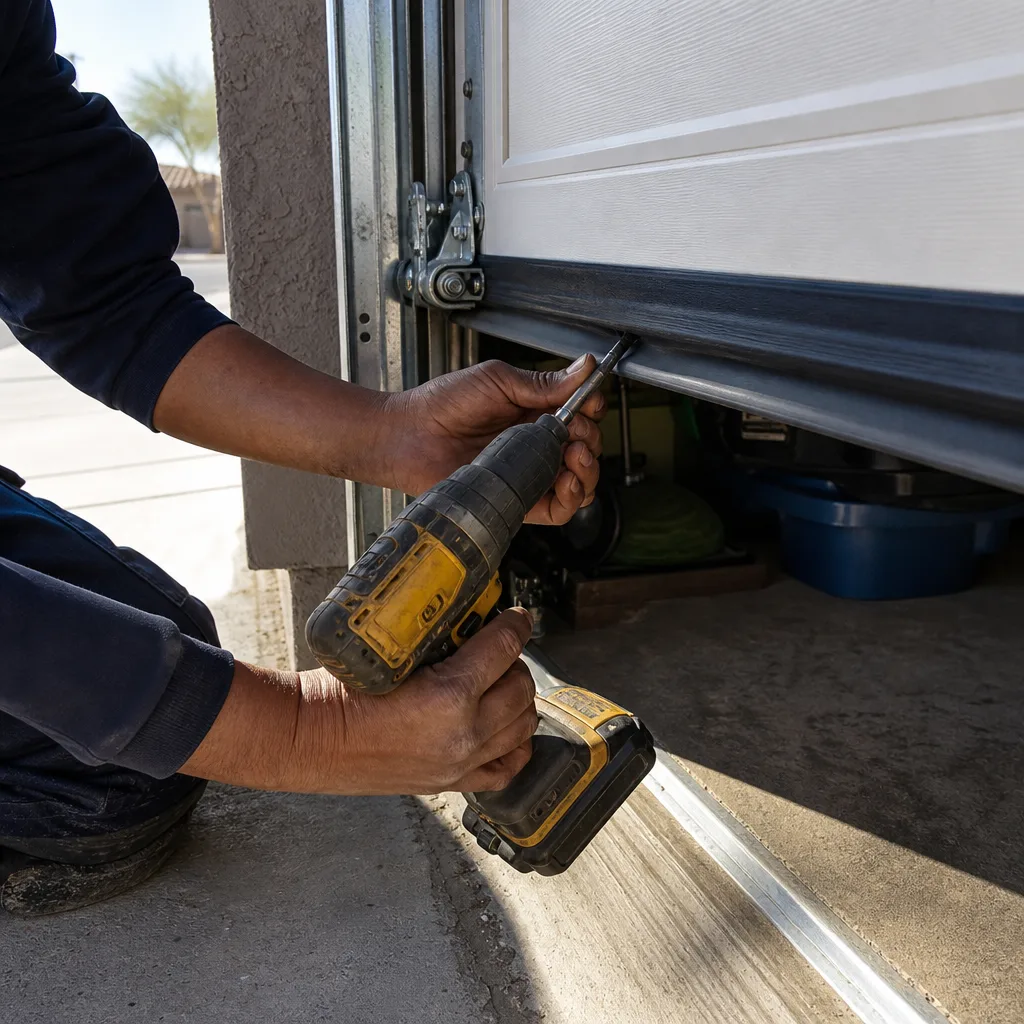
A Phoenix garage door fails in a predictable sequence: seals first, then rollers, then springs and cables, then opener components. The desert accelerates every stage, which means the national-average replacement intervals printed in most guides don’t apply here. The good news is that the sequence is knowable, the inspections are simple, and the repairs are affordable when caught early. Replace your bottom seal at the first sign of cracking, budget for springs at the 7-year mark, and read your data plate before approving any repair so you know whether you’re fixing the real system or patching a mismatch. That’s the difference between buying once and buying twice. If you want a professional assessment with documentation, garage door repair in Phoenix starts with a free estimate and ends with a photo record of what was found and what was done. Call (623) 404-9080.
Written by Marcus Deller, Owner at Servo Garage Doors Phoenix, serving Phoenix since 2015.